Fingerprint Patterns in Live Scan Checks: Unlock the Hidden Facts
Every fingerprint is considered the cornerstone of human identification. Whether you are applying for a license, a job, running a background check, or adopting children, a fingerprint pattern is the most essential way to check your identity. However, in this changing world, the traditional technique of using ink card prints has become outdated and is also a messy way. Live scan technology is reliable and secure, featuring fast digital scanning that makes the background verification faster.
Understanding Fingerprint Patterns
Forensic science says that fingerprints are the most reliable source of confirming someone's identity or background. The fingerprints also work as the primary source of evidence in a crime scene. The uniqueness of every fingerprint makes it a powerful tool while investigating a crime scene. Next, there are three types of fingerprint patterns to confirm people’s identity. Therefore, it is crucial to understand the three primary fingerprint patterns for aspiring forensic investigators. Let’s learn about the three fingerprint patterns:
1. Loops: The Most Common Fingerprint Pattern
The fingerprint services say that the loop fingerprint pattern exists within at least 60% to 65% of the population. The features of loop fingerprints are characterized by ridges that enter from one side, recurve, and exit from one side. So, such a distinguishing feature of the loop is the way the ridge lines enter from the side of the finger, curve upward, and then exit from the same side they entered. It generally appears like waves that roll back on themselves gently. The two types of loops are radial loops and ulnar loops.
Ulnar loops flow toward the little finger, which is the ulnar side of the finger. However, on the right-hand, the loop curves in one direction, and on the left-hand, it follows the opposite direction. Next, the radial loops are found to be less common and flow toward the thumb, which is the radial side of the hand.
2. Arches: The Rare Simplicity
Arch fingerprints are the most rare pattern, appearing in only 5% of the population. So, unlike whorls and loops, arches don’t come with any curve or circular formations. It instead has a rigid flow in a smooth and upward curve, crossing the finger from one side to the other with a gentle rise in the center. There are two types of arches: Plain and Tented.
The plain arches are simple, along with ridge lines evenly flowing across the finger, producing a small hill in the middle. However, the tented ones appear more dramatic, with ridges rising sharply to the point, showing a tent-like structure.
3: Whorls: The Complex Circular Pattern
Around 30% to 35% fingerprint patterns appear to be whorls, and they are the most intricate ones. Whorl is the most unique pattern due to its circular or spiral ridge formation, developing a pattern that radiates from the middle point. Whorls come with different varieties compared to loops or arches. The four types of whorls are plain, central pocket, double loop, and accidental.
The plain whorls consist of simple, concentric circles or spirals. Next, the fingerprint experts say that the central pocket whorls consist of only loop patterns. Double loop whorls contain two loop formations that twist around each other. Lastly, the accidental whorls are the most complex patterns that don’t fit into any category. This often contains the combination of arches, loops, and whorls in the most unique way.
Live Scan Technology to Identify Fingerprint Patterns
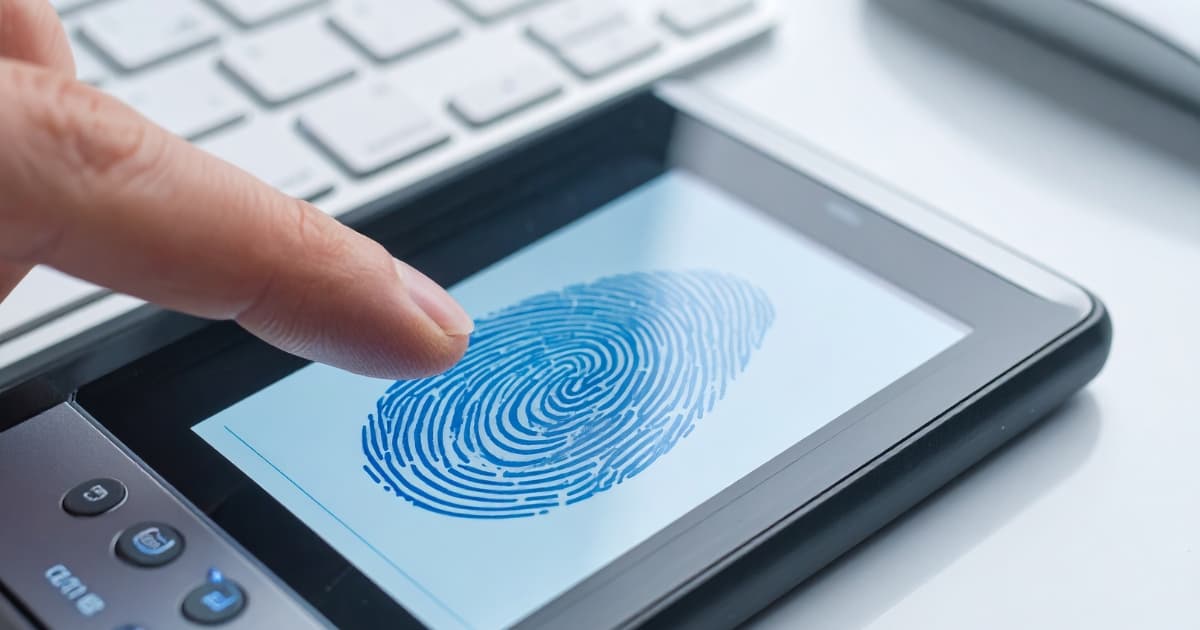
In recent times, live scan technology has successfully replaced the old ink and paper format of identification with digital technologies. So, how does it work? You need to place your finger on the glass screen, and then the machine will scan your prints. This is later submitted to the database, such as those of the Federal Bureau of Investigation (FBI) or Department of Justice (DOJ). Therefore, live scan technology is the fastest, cleanest, and most accurate process.
Science Behind Fingerprint Analysis
The science behind fingerprint analysis depends on unique and permanent friction ridge patterns created by the combination of genetics and environmental factors in the womb. Firstly, the fingerprints are captured with the help of ultrasonic, optical, or capacitive sensors. This process can also be done with the help of Live Scan to get the intricate ridge patterns of the fingers. After the prints are processed, the sensors convert the captured data to high-quality images so review them in seconds.
Next, after scanning the fingerprint is complete, the Live Scan system will start processing all the data obtained from the prints. The processing will be done with the help of an algorithm, then compare the prints against thousands of individuals until a match is found. Furthermore, the Automated Fingerprint Identification System (AFIS) plays a big role in this process. It is a huge database that stores as well as matches every fingerprint at lightning speed.
Boosting Accuracy in Live Scan
Increasing accuracy in Live Scan consists of the combination of the right technology with advanced technology. This involves applying even pressure while capturing the prints with the help of software with real-time quality checks and leveraging high-resolution scanners. These scanners must include the right algorithms to correct every error, such as partial prints or smudged prints. Furthermore, using multi-model biometrics and multi-finger scanners enhances precision and decreases the chances of false positives.
The accuracy of Live Scan can also be increased by maintaining the right level of cleanliness and moisture. Fingerprints are often too dry or not clean, compromising the scan quality and leading to false results or rejections. Thus, to get accurate results, keep your hands moisturized and keep them debris-free to obtain a high-quality scan.
Conclusion
Fingerprint patterns play a very important role in background checks and the modern identification process. So, the live scan technology enhances this process by providing cleaner, faster, and accurate results than the traditional methods. Therefore, by combining advanced scanners and precise algorithms, Live Scan ensures that the data provided is reliable identification, increasing security and trust in people.
Ready when you are
Book online in minutes — same-day appointments often available.
Explore our services: Fingerprinting · Notary · Apostille · Loan signing